From "I Wasn't Considering College" to a Job at Janos Technology, In One Year

Alex Chabak wasn't planning on college. Fresh out of high school, he was looking hard at becoming an electrician, but the union route wanted more experience than he had. He was questioning where to go next.
Then his mother sent him a link. She'd seen Keene State's Precision Optics Certificate program on social media and thought it might be worth a look. It was only two or three weeks before the semester started.
"The more I learned about the program, the more interested I got," Alex says. What sealed it wasn't the pitch, it was the price. "I wasn't really considering college. I was scared of the price, but once this was broken down to show the grant and how much aid was available, it made the decision easy."
That's the thing prospective students don't always know going in: financial aid and grants can cover most of the expenses in this program, and it's not a four-year commitment. It's one year.
Day one, in the lab, not a lecture hall
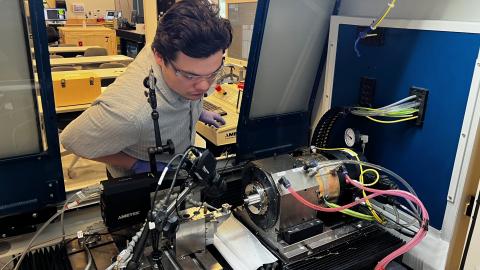
Alex had a small head start. He'd picked up photography, shooting local athletics events, and had a basic feel for lenses. But he says nothing prepared him for how deep the program actually went. On his first day, he was already at hands-on stations: thin film coatings, lasers at different power levels, mirrors, the building blocks of the whole field, taught by doing, not by slides.
Physics Chair Dr. Sarah McGregor gave him his first tour.
A pipeline straight into the industry
Alex connected with Janos Technology at an industry seminar Keene State hosted on campus, one of many chances students get to meet the 30+ regional optics companies that partner with the program directly. He went straight to work for Janos. He wasn't alone: three of the seven students in his cohort moved directly into jobs with industry partners, others started paid internships to learn more before committing.
"It helps to have the optics certificate to negotiate and open up opportunities," he says. "There are endless opportunities in this area."
What the job actually looks like
Today, Alex is a diamond turning machinist at Janos. Day to day, he's setting up machines, running parts, troubleshooting, and picking up new tricks of the trade. Two weeks into the job, he was already working on advanced techniques.
He laughs about the assumptions people make. "Everyone always asks if I'm working with photography or glasses." In reality, he's cutting materials like germanium and zinc selenide, used in everything from infrared filtering systems to military optics, on equipment that most people never get near.
His advice for anyone joining the program
"Take good notes," Alex says. "There's a lot to remember, sometimes it's one very specific thing you'll need to recall later in the process." And beyond that: "Be open-minded and learn as much as you can, because the information is so valuable."
Alex moved to the Monadnock Region from Bloomfield, CT for the certificate, and he's stayed. He's even considering coming back to Keene State in a few years for the Sustainable Product Design engineering program.
See what a year could open up for you
If you're not sure college is for you, or you're weighing a career change, Alex's path is worth a look. Visit keene.edu/optics to see the program, the lab, and what a one-year certificate could open up for you.